2026 Best Crystal Types for Wholesale Buyers

Crystals are not one uniform wholesale category. Amethyst, clear quartz, rose quartz, agate, and labradorite differ in color consistency, durability, processing, and buyer appeal. For 2026, wholesale buyers need to assess more than popular names. They should compare supplier reliability, grading practices, minimum order quantities, packaging, and the consistency of samples against bulk shipments. A vivid sample is not a guarantee of a uniform lot.

Grand View Research estimated the global gemstone market at USD 32.38 billion in 2023 and projected a 6.2% compound annual growth rate from 2024 to 2030. Its report covers gemstones broadly, including jewelry applications; it does not measure demand for crystal décor or wholesale mineral specimens specifically. That distinction matters. The figure offers market context, not a direct sales forecast for any crystal type. Still, market forecasts are not purchase orders.

This guide compares crystal types through practical buying criteria: recognizable appearance, availability, finish options, and likely fit across retail and décor channels. It also considers trade-offs. Amethyst may be familiar to shoppers, while less common stones can create a distinctive display but bring uneven color or supply. Buyers should request clear product specifications, current photographs, and written confirmation of material and treatments. Where supplier information is incomplete, pause and verify. The best choice is rarely the most dramatic stone alone; dependable quality and repeatable sourcing matter just as much.
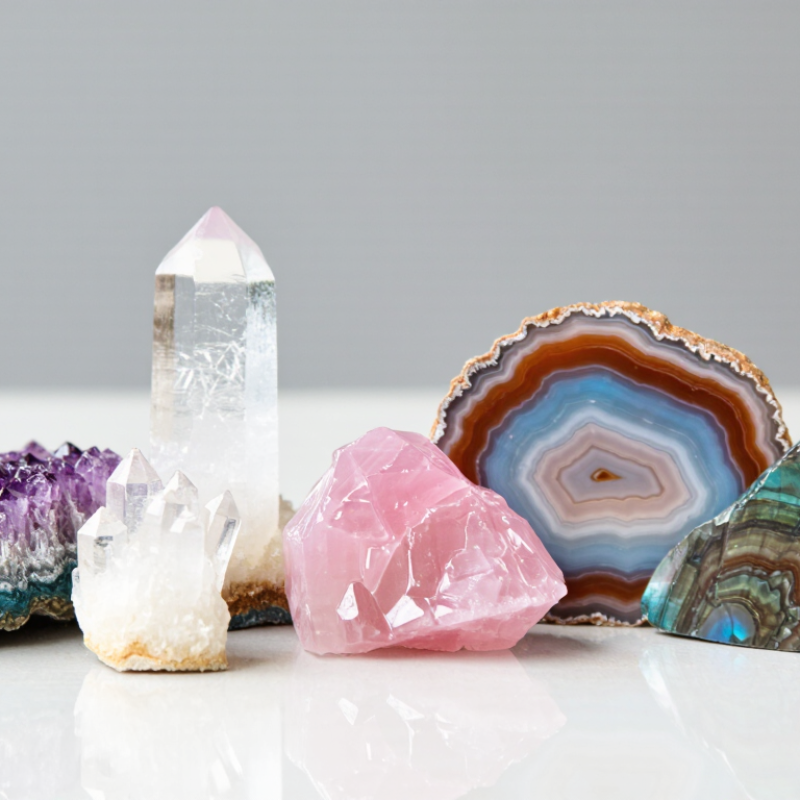
2026 Best Crystal Types for Wholesale Buyers

Build a Wholesale Crystal Shortlist Using Mohs Hardness Ratings

2026 Best Crystal Types for Wholesale Buyers

Build a wholesale shortlist around Mohs hardness, which measures scratch resistance from 1 to 10. It helps compare everyday handling needs, but it does not predict every breakage risk. Quartz, including amethyst and many agates, rates about 7 and suits buyers seeking harder stones. Fluorite rates 4, while calcite rates 3. These softer choices may need more careful packing and display.

Match ratings to the way customers will use each item. For frequently handled pieces, consider quartz varieties and inspect polished surfaces for chips or scratches. For decorative collections, fluorite and calcite offer different colors and forms, but their lower ratings call for protective dividers in wholesale cartons. Selenite, a gypsum variety, is especially soft at about 2. Keep it away from harder stones. Small scratches add up.

Mohs ratings are a starting point, not a complete quality grade. Cleavage, internal fractures, shape, and finishing can affect how a piece withstands impact. A hard crystal can still chip if it has a weak edge. Compare samples from several pieces in a batch, and ask suppliers how stones are sorted and packed. I would not build a buying decision around one number alone; that shortcut is tempting, but incomplete.

Compare Quartz Varieties: Amethyst and Citrine (Mohs 7), Agate (6.5–7)

Amethyst and citrine are both quartz, with a Mohs hardness of 7. That makes them suitable for many everyday jewelry designs, though hardness measures scratch resistance, not resistance to impact. A sharp knock can still chip a faceted edge. Amethyst ranges from pale lilac to deep violet; citrine typically runs from soft yellow to golden brown. Check color consistency across a parcel, since shade affects how well stones match in finished pieces.

Ask for specifics. Commercial citrine may be heat-treated amethyst, so buyers should request clear treatment disclosures and record them with purchase details. This is a practical sourcing step, not a judgment on value: treatment can be acceptable when accurately described. Compare sample stones under neutral light, then inspect them again under the lighting used in your showroom.

Agate usually measures 6.5–7 on the Mohs scale, close to quartz, but its banding and translucency vary widely. Look for chips along cut edges, uneven polish, and color that appears concentrated in cracks. Hardness alone does not tell the whole story. I would not choose a lot from a single attractive specimen; reviewing several pieces can reveal variation that the sample hides. Ask suppliers how they grade, disclose, and pack each variety before setting order expectations.

Assess Fluorite (Mohs 4) and Calcite (Mohs 3) for Color-Led Collections

For a color-led wholesale collection, fluorite and calcite offer broad visual range without relying on unusual shapes. Fluorite, at Mohs 4, often appears in clear greens, purples, and banded combinations. Its color zoning can make matched sets lively, though it also makes exact pair-matching difficult. Inspect pieces under neutral light; strong shop lighting may hide cloudy areas or uneven polish. Color sells first. But fluorite has distinct cleavage, so chips can occur if parcels are packed loosely.

Calcite, Mohs 3, brings saturated yellows, oranges, blues, and soft whites, often with a waxy-looking luster. It scratches easily and reacts with acids, so avoid rough contact and acidic cleaners. For wholesale buying, request consistent size ranges, clear grading notes, and photos of representative lots rather than one ideal specimen. Ask how pieces are protected in transit; individual sleeves or padded dividers can reduce abrasion. Still, color is not a quality grade by itself. Cloudy or uneven pieces may suit affordable mixed trays, but only when that variation is disclosed. A small sample order is prudent. I would not overpromise uniformity.

2026 Best Crystal Types for Wholesale Buyers — Assess Fluorite (Mohs 4) and Calcite (Mohs 3) for Color-Led Collections

Buying Dimension Fluorite Calcite Wholesale Collection Consideration
Mohs hardness 4 3 Both are relatively soft compared with quartz (Mohs 7). Plan for protective packaging and advise customers to keep pieces away from harder minerals and abrasive surfaces.
Crystal system Isometric (cubic) Trigonal Crystal form can add visual variety to a display, but individual specimens vary in shape, finish and degree of crystal development.
Common color range Colorless, purple, green, blue, yellow and color combinations; color may vary within a specimen. Colorless, white, gray, yellow, orange, pink, red, green and brown, depending on the specimen. Use specimen-specific descriptions and photographs. Color is variable, so avoid promising an exact shade across a wholesale lot.
Transparency and appearance Can range from transparent to translucent or opaque; banding and zoning may occur. Can range from transparent to opaque; crystal habit and surface finish affect appearance. Sort and grade by visible characteristics such as color, clarity, banding, form and finish rather than mineral name alone.
Cleavage and handling Perfect octahedral cleavage in four directions; can break along cleavage planes. Perfect rhombohedral cleavage in three directions; can split into rhombohedral pieces. Use individual compartments or cushioning in transit. Inspect edges and corners, especially on faceted or naturally formed pieces.
Approximate specific gravity About 3.18 About 2.71 Useful as a reference when comparing similar-sized specimens, but it is not a substitute for identification or lot inspection.
Fluorescence Some specimens fluoresce under ultraviolet light, often blue or violet; response varies. Some specimens fluoresce under ultraviolet light; color and intensity vary. If fluorescence is part of the product description, verify the actual pieces under the stated UV wavelength and disclose that not all specimens respond.
Care considerations Handle gently and avoid impact, abrasion and prolonged exposure to strong direct sunlight, which may affect color in some specimens. Handle gently; avoid acids, which react with calcite, and avoid abrasive cleaning. Provide care instructions appropriate to the specific product form. Do not imply that every specimen has identical light or handling sensitivity.
Color-led merchandising Suitable for a palette organized around purple, green, blue and multicolor zoning. Offers a broad palette, including neutral, warm and pastel tones. Build assortments around documented color groups and consistent grading. Treat these as merchandising suggestions, not guarantees of lot uniformity.

Buyer note: Mineral properties and appearance can vary between specimens. Confirm grade, dimensions, finish, color range and packaging requirements against the actual lot before placing a wholesale order.

Evaluate Premium Options: Topaz (Mohs 8) and Corundum (Mohs 9)

2026 Best Crystal Types for Wholesale Buyers

Evaluate Premium Options: Topaz (Mohs 8) and Corundum (Mohs 9)

For wholesale buyers, topaz and corundum offer high hardness, but they behave differently in handling. Topaz ranks 8 on the Mohs scale; corundum ranks 9. That difference matters for scratch resistance, yet Mohs hardness is not a measure of impact strength. Topaz has pronounced cleavage, so a sharp knock may cause damage even when its surface resists scratches. Corundum has no cleavage and is generally a sturdier choice for pieces exposed to frequent wear. Small details matter.

When comparing lots, inspect representative stones under neutral light. Check color consistency, visible inclusions, cutting quality, and any chips near edges or corners. Ask suppliers for clear disclosure of identity and known treatments, plus consistent grading criteria across the shipment. A bright sample can look excellent alone, then feel less uniform beside the full parcel. I would not rely on hardness alone; it is useful, but it cannot replace careful inspection or a clear return agreement.

Tips: Request several pieces from the actual lot, not only a showcase sample. Use a loupe and soft cloth during inspection, and document mismatches before accepting delivery. Recheck your criteria after each order; a grading checklist can still miss what matters to your customers.

Check Supplier Data for Treatments, Mineral Identity, and Lot Consistency

For wholesale buyers, a crystal’s name is only a starting point. Ask suppliers to state the mineral species, trade name, and common look-alikes separately. A label such as “blue agate” may describe appearance, not a precise mineral identity.

Treatment records matter. Request written disclosure of dyeing, heating, coating, impregnation, or other enhancement, including the method used when known. Compare the disclosure with close-up photos taken in neutral light. Vivid color around drilled holes can be a clue, but it is not proof. Keep invoices and batch notes together, especially when treatment affects pricing or display labels.

Lot consistency is practical, not merely cosmetic. Request measurements for several pieces, not just one selected sample. Compare color, translucency, fracture patterns, and average weight. For a 500-piece order, sample from different cartons; one attractive pouch can hide variation. Sampling has limits. Ask for dated photos, lot numbers, and a retained reference specimen. If supplier data are incomplete, narrow the order or pause rather than fill gaps with assumptions. Wording can change between batches; that deserves a question, though it may be clerical drift. A certificate is not a guarantee. Check that it identifies the actual lot and the tests performed.

2026 Best Crystal Types for Wholesale Buyers

Compare Mohs hardness ranges for common crystal materials. Hardness is a useful material reference, not proof of mineral identity or treatment.

Supplier checks: Request mineral identity documentation, written disclosure of any treatments, and consistent identification and treatment records for each lot. Mohs hardness is a relative scratch scale; results can vary within a material.

Article Source:

This website uses cookies to ensure you get the best experience possible. Learn more.