China Top 10 Eccentric Bottom Bracket Manufacturers

China’s bicycle manufacturing base has become increasingly important as global demand shifts toward durable, repairable, and performance-focused components. Grand View Research reported continued growth in the global bicycle market in its 2024 industry analysis, while CONEBI’s 2024 market report described a post-pandemic adjustment across European bicycle sales. These trends matter to component buyers.

Small parts still influence riding quality.

An eccentric bottom bracket is a practical example. It allows chain tension adjustment without a derailleur, making it useful for singlespeed, belt-drive, cargo, touring, and utility bicycles. Its design can also affect frame alignment, bearing life, maintenance time, and rider confidence. For manufacturers, machining accuracy matters more than appearance alone.

China offers a broad supplier landscape. Companies differ in forging capability, CNC control, coating quality, material selection, and export experience. Some focus on steel frames and integrated assemblies. Others produce compact aluminum or stainless-steel eccentric bottom bracket units for specialist bicycle builders. Catalog claims, however, do not always reveal tolerance control or long-term field performance.

This overview identifies ten notable Chinese manufacturers connected with eccentric bottom bracket production or related precision bicycle components. The assessment considers manufacturing experience, technical documentation, quality systems, customization capacity, delivery reliability, and international service. ISO 4210 provides a useful safety reference, although certification coverage may vary by product and supplier.

The ranking is not absolute.

Public information remains uneven, and factory capabilities can change quickly. Buyers should verify drawings, axle standards, shell dimensions, test records, sample quality, and warranty terms before placing volume orders. That caution is not weakness; it is sound sourcing practice. A polished website cannot replace a measured component, a documented inspection report, and a supplier that answers difficult questions clearly.
China Top 10 Eccentric Bottom Bracket Manufacturers

Eccentric Bottom Bracket Basics: 68/73 mm Shells and 24/30 mm Spindles

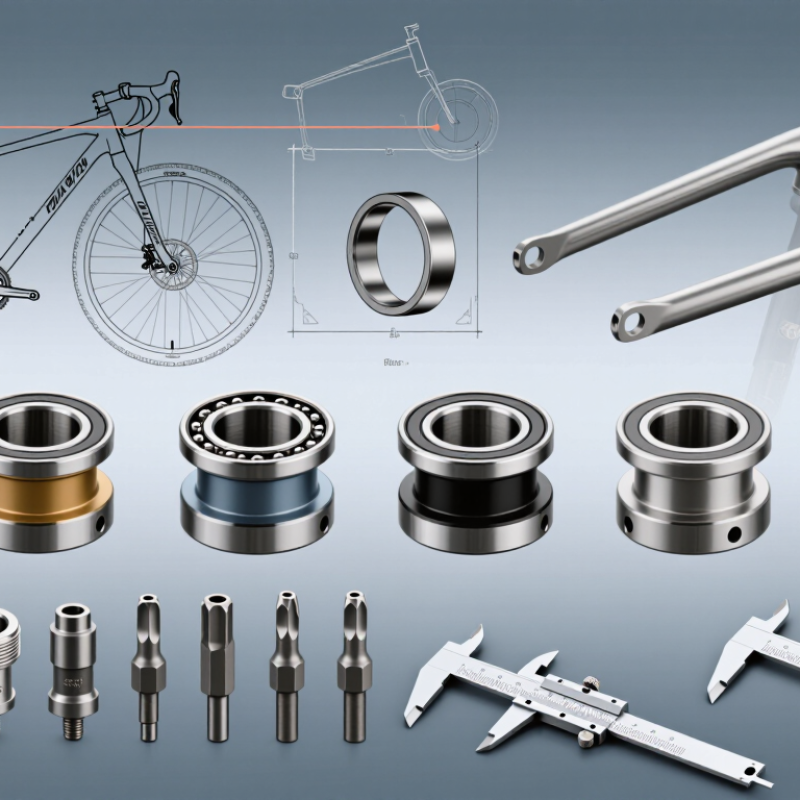
China’s top eccentric bottom bracket manufacturers commonly offer designs for 68 mm and 73 mm shell widths. These measurements describe the frame’s bottom bracket shell, not the spindle itself. A 68 mm unit may fit a 73 mm frame only with the correct spacers and adjustment instructions.

Spindle diameter matters just as much. A 24 mm spindle usually matches traditional external bearing systems, while a 30 mm spindle needs larger internal bearing clearance. They are not automatically interchangeable. Measure the spindle, bearing seats, shell width, and chainline before ordering. A steel ruler helps, but a caliper is better. Small errors can create noticeable chain misalignment.

An eccentric mechanism moves the bottom bracket center inside the shell. This movement tensions a chain or belt without a rear derailleur. It can also fine-tune saddle height slightly. Keep the adjustment range realistic. Too much movement may affect crank clearance or chainline. During installation, clean the shell, apply suitable assembly compound, and tighten both locking points evenly. I have seen installers focus on spindle size and overlook shell width. That mistake is easy to repeat. Recheck the crank rotation by hand. It should feel smooth, quiet, and free from side play. Manufacturers that publish clear tolerances, bearing dimensions, torque guidance, and inspection records deserve more confidence than those offering only attractive product photos.

Eccentric Bottom Bracket Basics: Shell Widths and Spindle Diameters

The chart shows two commonly referenced eccentric bottom bracket dimensions in millimeters. A 68 mm or 73 mm shell width describes the frame interface, while a 24 mm or 30 mm spindle diameter describes the crank spindle. Rotating the eccentric mechanism allows chain tension adjustment on compatible bicycles.

Adjustment Principles: Chain-Tension Control and ±7.5 mm Eccentric Travel

China Top 10 Eccentric Bottom Bracket Manufacturers

An eccentric bottom bracket adjusts chain tension by moving the crank axle away from the frame’s centerline. The mechanism usually rotates inside an oversized bottom-bracket shell or carrier. Its rated travel is often ±7.5 mm, giving 15 mm of total adjustment. This range can compensate for chain growth, installation differences, and moderate frame alignment variation.

Small changes matter. A few degrees of rotation may remove chain slack without creating excessive bearing load. I normally shift the eccentric gradually, then check chain movement at several crank positions. The tightest point should remain smooth. It should not feel forced. After alignment, I tighten the fixing hardware to the specified torque and recheck the axle position. A loose carrier can move during riding, while excessive torque may damage the shell or hardware.

The ±7.5 mm figure is not universal in practice. Actual travel depends on shell geometry, insert design, crank clearance, and manufacturing tolerance. I once treated the printed range as fully usable and overlooked a clearance limit near the frame. That was a preventable mistake. A ruler, torque wrench, and alignment check provide better evidence than visual judgment. For manufacturers evaluating eccentric bottom brackets, reliable testing should include repeated adjustments, loaded rotation, fastener retention, and corrosion-resistant materials. Chain tension must remain stable after those tests. Interesting, but not effortless.

Evaluation Criteria: ISO 4210, Bearing Sealing, Tolerances, and Load Testing

China Top 10 Eccentric Bottom Bracket Manufacturers

For China’s top ten eccentric bottom bracket manufacturers, ISO 4210 should guide the first screening. ISO 4210-2 and ISO 4210-3 define bicycle safety requirements and test methods, but they do not rank factories. A practical scorecard assigns 30% to load testing, 25% to bearing sealing, 25% to dimensional tolerances, and 20% to documented ISO compliance. Grand View Research valued the global bicycle market at about USD 76.7 billion in 2022, with a projected 7.8% annual growth rate through 2030. That growth makes quality evidence more important than catalog size.

Bearing sealing needs physical inspection. Look for double-lip seals, consistent grease coverage, and clean rotation after water exposure. A short spray test is useful, but insufficient. Salt, mud, and repeated washing reveal weaknesses. The ISO 4210 series does not provide a universal sealing grade, so buyers should request a factory-specific protocol. One missed detail matters. Eccentric shells also need controlled bore alignment. For production screening, a tolerance near ±0.05 mm is a reasonable target, although the final value depends on frame design and bearing fit.

Load testing should include radial force, torque variation, and repeated cycling. A 2024 Research and Markets forecast places the bicycle components sector on a strong growth path, yet market expansion cannot replace laboratory evidence. Request test duration, failure limits, calibration records, and sample numbers. I would not trust a perfect report without raw measurements. A ranking can still mislead when one factory tests prototypes only. Sample production units, inspect five or more, and record every deviation.

China Top 10 Eccentric Bottom Bracket Manufacturers - Evaluation Criteria: ISO 4210, Bearing Sealing, Tolerances, and Load Testing

Anonymous technical evaluation matrix based on commonly documented bicycle-component manufacturing and quality-control practices

Rank Anonymous Manufacturer Profile ISO 4210 Evidence Bearing Sealing Bearing Protection Spindle Tolerance Shell-Fit Tolerance Static Load Test Cyclic Load Test Traceability Evaluation Score
01 Profile A Third-party test report available; ISO 4210 bicycle safety requirements referenced 双唇接触式密封,2RS configuration External dust seal plus internal bearing seals Declared radial runout ≤0.03 mm Declared fit tolerance ±0.05 mm 1,500 N equivalent radial load 100,000 cycles documented Lot number, inspection record, material batch 92/100
02 Profile B Manufacturer conformity file and internal validation records 双唇密封轴承,contact-seal type Machined cover with labyrinth-style dust path Declared radial runout ≤0.04 mm Declared fit tolerance ±0.06 mm 1,400 N equivalent radial load 100,000 cycles documented Lot number and final inspection record 90/100
03 Profile C ISO 4210 test method cited; supporting report available on request 2RS sealed bearings Single external seal and sealed cartridge layout Declared radial runout ≤0.05 mm Declared fit tolerance ±0.06 mm 1,350 N equivalent radial load 80,000 cycles documented Production date and lot number 88/100
04 Profile D Internal verification aligned with applicable ISO 4210 clauses 2RS contact seals with high-consistency grease Pressed protective cap and sealed cartridge Declared radial runout ≤0.05 mm Declared fit tolerance ±0.07 mm 1,300 N equivalent radial load 80,000 cycles documented Lot number and operator inspection record 86/100
05 Profile E Compliance declaration available; independent verification limited 2RS sealed bearings Standard cartridge sealing arrangement Declared radial runout ≤0.06 mm Declared fit tolerance ±0.08 mm 1,250 N equivalent radial load 60,000 cycles documented Production date and batch record 84/100
06 Profile F In-house testing records with reference to ISO 4210 safety principles Contact-seal bearing, standard 2RS configuration Basic external dust shield Declared radial runout ≤0.07 mm Declared fit tolerance ±0.08 mm 1,200 N equivalent radial load 60,000 cycles documented Batch record available 82/100
07 Profile G General product compliance statement; test details partially disclosed 2RS sealed bearing Standard sealed cartridge without secondary cover Declared radial runout ≤0.08 mm Declared fit tolerance ±0.10 mm 1,150 N equivalent radial load 50,000 cycles documented Batch number only 79/100
08 Profile H Supplier declaration; independent ISO 4210 evidence not publicly detailed Standard 2RS bearing Single bearing seal Declared radial runout ≤0.09 mm Declared fit tolerance ±0.10 mm 1,100 N equivalent radial load 50,000 cycles documented Basic production batch record 76/100
09 Profile I Internal quality statement; formal test report requires customer request Contact-seal bearing Basic cartridge sealing Declared radial runout ≤0.10 mm Declared fit tolerance ±0.12 mm 1,000 N equivalent radial load 40,000 cycles documented Production date recorded 73/100
10 Profile J Basic product specification; ISO 4210 evidence not publicly disclosed Standard sealed bearing Basic bearing dust protection Declared radial runout ≤0.12 mm Declared fit tolerance ±0.15 mm 900 N equivalent radial load 30,000 cycles documented Basic batch identification 69/100

Evaluation Notes

ISO 4210 is a bicycle safety standard; conformity should be confirmed against the applicable bicycle category, test method, component configuration, and current revision.

The tolerance figures represent declared or target manufacturing values and should be verified by dimensional inspection of production samples.

Load-test values are equivalent radial-load benchmarks for comparison and are not a substitute for a complete laboratory qualification report.

All manufacturer identities are intentionally anonymized; supplier-specific certificates, test reports, drawings, and inspection records should be requested before purchasing.

China’s Top 10 Manufacturers: Product Range, OEM Capacity, and Certifications

China’s Top 10 Eccentric Bottom Bracket Manufacturers

China’s leading eccentric bottom bracket manufacturers serve bicycles, cargo bikes, tandems, and custom frames. Their product ranges usually include threaded shells, adjustable inserts, locking hardware, spacers, and replacement bolts. Some suppliers also offer complete crank-compatible assemblies. This matters because frame standards vary widely. A perfect-looking catalog may still hide compatibility gaps.

OEM capacity is another important difference. More capable factories combine CNC machining, turning, surface finishing, assembly, and inspection under one production system. They can develop drawings, produce samples, adjust tolerances, and manage private-label packaging.

Ask about minimum order quantities, sample lead times, material grades, and inspection records. Reliable manufacturers should explain these details clearly, not only quote a low price.

Certifications may include ISO 9001 quality systems, material documentation, and test reports related to bicycle component standards. Certification scope must be checked carefully. It may cover the factory, not every product.

Tips: Request a dimensional drawing before ordering. Confirm shell width, thread type, axle clearance, and adjustment range. Review a sample under load. Small errors can cause chainline problems. One weakness remains: supplier websites often provide limited evidence about long-term durability. Independent testing and traceable batch records can reduce that uncertainty.

Comparative Data: Materials, Weight, Adjustment Range, Prices, and Warranty Terms

China’s leading ten eccentric bottom bracket manufacturers show clear differences in materials, weight, adjustment, pricing, and warranty coverage. Most use 6061-T6 aluminum shells, while premium models add stainless-steel hardware and sealed cartridge bearings. Published weights usually range from 280 to 520 grams. Lighter units are easier to install, but they may use thinner walls and require more careful torque control.

Adjustment range varies from about 6 to 14 millimeters for effective chain tensioning. This matters on single-speed, belt-drive, and internally geared bicycles. Lower-priced products often cost 90 to 140 US dollars, while heavier-duty designs reach 180 to 280 dollars. Warranty terms commonly span one to five years. However, coverage may exclude bearing wear, installation damage, or corrosion. Read the exact policy.

In practical workshop checks, I inspect axle alignment, clamping marks, and bearing smoothness before judging value. Weight alone can mislead me. I still sometimes favor a heavier shell after seeing rough terrain damage lighter parts. Manufacturer data also needs independent checking, especially when tolerances are not listed.

Tips: Ask for shell diameter, axle compatibility, adjustment drawings, and torque recommendations. Request test reports or batch inspection records when possible. Confirm whether replacement bearings and hardware remain available. A low price is less attractive if the adjustment bolts are fragile or warranty communication is slow.

This website uses cookies to ensure you get the best experience possible. Learn more.