Top 10 Warning Light Manufacturers for Global Buyers
Warning lights are no longer simple red bulbs on a dashboard. They now combine LEDs, optical lenses, wireless controls, and rugged housings. Buyers must evaluate brightness, visibility, response time, service life, and regional compliance.
Industry data supports this growing complexity. Allied Market Research valued the global automotive lighting market at approximately USD 22.5 billion in 2021. Its report projects the market to reach about USD 34.1 billion by 2031. MarketsandMarkets also identifies LED adoption, vehicle electrification, and intelligent safety systems as major growth drivers. These trends affect emergency beacons, industrial stack lights, vehicle light bars, and warning modules.
Performance matters in the field.
A warning lamp beside a noisy loading dock must remain visible through dust, rain, and machinery vibration. A roof-mounted beacon must maintain consistent flash patterns during long operating hours. These details separate a reliable Warning Light Manufacturer from a basic component supplier.
This guide reviews ten manufacturers serving global buyers. The comparison considers product range, optical performance, enclosure protection, certifications, customization, delivery capability, and after-sales support. Standards such as SAE J595 and UNECE Regulation No. 65 can help buyers assess visual warning performance. However, compliance depends on the product, vehicle type, and market.
No ranking is perfect. Supplier strengths change by application, region, and production cycle. Buyers should verify current test reports, IP ratings, warranty terms, and sample performance before placing large orders. A polished catalog is useful, but measured field results are more convincing.
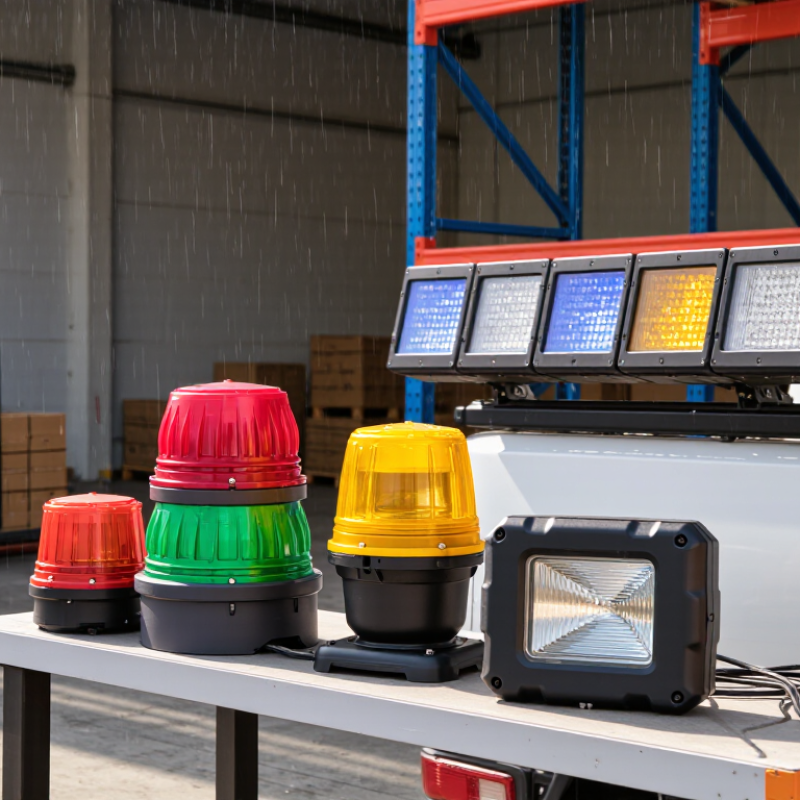
Defining Warning Lights: Beacon, Strobe, Tower, and Signal Categories
Warning lights are not interchangeable, even when their housings look similar. A beacon usually provides a rotating or simulated rotating signal. Its broad light pattern helps workers notice movement around vehicles, gates, and machinery. A strobe produces short, intense flashes. It suits locations requiring rapid visual attention, especially noisy production areas. However, excessive flash intensity can distract nearby operators.
Tower lights use stacked segments, with each color showing a different machine condition. Green may indicate normal operation, while amber can signal caution. Red often identifies a stop condition. Some towers include audible modules, but sound levels must match the working environment. Signal lights are a wider category. They can include fixed indicators, panel lamps, and compact status lights. Their purpose is usually communication rather than area illumination.
Experienced buyers should match the category to viewing distance, ambient light, vibration, and mounting position. A roof-mounted beacon needs weather resistance and a stable base. A tower light needs clear color separation from several angles. Check voltage range, flash pattern, lens material, ingress protection, and operating temperature. Ask for test records and photometric data, not only catalog claims. I once treated color visibility as a minor detail; sunlight proved otherwise. That mistake changed our inspection checklist. Not every bright light communicates clearly. Supplier consistency also matters. Sample testing, wiring checks, and repeated cycle tests can reveal faults before installation.
Ranking the Top 10 Manufacturers by IEC 60529 IP Ratings and Product Range
Top 10 Warning Light Manufacturers for Global Buyers
This ranking evaluates ten warning light manufacturers through IEC 60529 IP ratings, product breadth, and documented testing. IP65 means dust-tight protection and resistance to water jets. IP66 adds stronger water-jet protection. IP67 covers temporary immersion, while IP68 depends on conditions stated by the manufacturer. These distinctions matter near washdown lines, outdoor cabinets, and dusty processing areas.
Product range also separates strong suppliers from narrow specialists. The ranking reviews stack lights, beacons, sounders, machine lamps, explosion-protected options, and network-compatible signals. MarketsandMarkets valued the industrial automation market at approximately USD 191.9 billion in 2024 and projects about USD 265.9 billion by 2029. That expansion increases demand for visible, durable signaling equipment. Still, market growth does not prove product reliability.
Testing evidence remains more useful than catalog language. Buyers should request IP test reports, operating-temperature data, photometric details, and service-life assumptions. A claimed IP rating can describe the enclosure, not the complete installed assembly. That distinction is easy to miss. UL Solutions and other conformity laboratories stress controlled testing, yet field conditions can include vibration, chemicals, incorrect cable glands, and aging seals. My ranking therefore gives higher weight to verified ratings across multiple product families, not one impressive enclosure. Some manufacturers offer broad catalogs but limited documentation. That weakness deserves a penalty.
Comparing 12 VDC, 24 VDC, and 110–240 VAC Warning Light Options
For global buyers comparing the top ten warning-light manufacturers, voltage compatibility should guide the shortlist. A 12 VDC light suits vehicles, battery systems, and compact mobile equipment. A 24 VDC model fits modern control cabinets and programmable automation systems. This voltage is common in sensors, relays, and machine-control circuits. For fixed installations, 110–240 VAC options reduce the need for separate power supplies. However, wide-range AC ratings still require frequency, inrush-current, and regional wiring checks.
The IFR World Robotics 2024 report recorded 541,302 industrial robot installations worldwide in 2023. More automated cells mean clearer visual alarms near conveyors, presses, and access doors. In these environments, 24 VDC often simplifies integration with safety controllers. Yet voltage alone does not prove suitability. Buyers should verify IP protection, operating temperature, light intensity, flash patterns, and expected service life. IEC 60204-1 also provides a useful reference for electrical equipment on machinery.
A practical test uses the real cabinet. Measure voltage at the light terminals, not only at the power supply. Cable length can create noticeable drops. A 12 VDC unit may appear attractive, but it can demand thicker wiring over distance. A 110–240 VAC unit may simplify distribution, yet isolation and installation procedures become more demanding. I would not rank suppliers by voltage range alone. That approach looks efficient, but it misses connector quality, replacement access, and regional certification evidence. Each manufacturer should provide clear datasheets, test conditions, and traceable technical support.
Top 10 Warning Light Manufacturers for Global Buyers - Comparing 12 VDC, 24 VDC, and 110–240 VAC Warning Light Options
Technical comparison of commonly available warning-light configurations. Electrical ratings, certifications, and operating limits should be verified against the final product datasheet. | Profile | Typical Product Format | Input Voltage | Typical Current Draw | Light Source | Ingress Protection | Typical Operating Temperature | Common Mounting | Common Applications |
| 01 | Compact LED beacon | 12 VDC | 0.15–0.60 A | High-intensity LED array | IP65–IP67 | −30°C to +50°C | Magnetic, stud, or surface mount | Service vehicles, compact machinery, mobile equipment |
| 02 | Industrial LED beacon | 24 VDC | 0.10–0.40 A | LED, steady or flashing | IP66–IP67 | −30°C to +60°C | Base, side, or conduit mount | Factory automation, conveyors, control panels |
| 03 | Multi-voltage LED beacon | 12–24 VDC | 0.10–0.80 A | High-output LED modules | IP65–IP68 | −40°C to +60°C | Three-point or pole mount | Fleet vehicles, agricultural equipment, outdoor machinery |
| 04 | Stack light module | 24 VDC | 0.03–0.20 A per segment | LED segment, fixed color | IP54–IP65 | −20°C to +50°C | Modular base or panel mount | Machine status, production lines, material handling |
| 05 | Audible-visual indicator | 12 or 24 VDC | 0.20–1.00 A | LED plus electronic sounder | IP54–IP66 | −25°C to +55°C | Surface or panel mount | Warning panels, access control, process alarms |
| 06 | AC industrial beacon | 110–120 VAC | 0.02–0.15 A | LED or xenon, depending on design | IP54–IP66 | −20°C to +50°C | Base, wall, or conduit mount | North American industrial equipment and facilities |
| 07 | Universal-voltage beacon | 110–240 VAC | 0.02–0.12 A | LED array | IP65–IP67 | −30°C to +60°C | Surface, wall, or conduit mount | International plants, utilities, warehouses |
| 08 | Explosion-protected warning light | 24 VDC or 110–240 VAC | 0.03–0.30 A | Encapsulated LED | IP66–IP68 | −40°C to +60°C | Certified conduit or bracket mount | Hazardous-area process plants, oil and gas, chemical facilities |
| 09 | High-visibility strobe light | 12–24 VDC | 0.50–2.50 A | High-power LED or xenon tube | IP65–IP67 | −30°C to +50°C | Permanent, magnetic, or suction mount | Emergency vehicles, roadside maintenance, construction equipment |
| 10 | Panel-mount signal indicator | 12 VDC, 24 VDC, or 110–240 VAC | 0.005–0.08 A | Front-panel LED | IP40–IP65 front protection | −20°C to +55°C | Panel cut-out or flush mount | Control cabinets, electrical panels, instrumentation |
Buyer checklist: Confirm nominal voltage tolerance, inrush current, flash pattern, color wavelength, sound level where applicable, EMC performance, cable entry, certification requirements, and the exact IP or hazardous-area rating before purchase.
Checking CE, UL 508, IEC 60947-5-1, and RoHS Compliance
Top 10 Warning Light Manufacturers for Global Buyers
Checking CE, UL 508, IEC 60947-5-1, and RoHS Compliance
When comparing ten warning light manufacturers, compliance documents deserve more attention than product photos. A clear CE Declaration of Conformity should identify the exact model, applicable directives, and responsible manufacturer. Do not accept a generic certificate covering an entire product family without evidence. Details matter.
Ask for UL 508 certification or listing information when the light enters industrial control equipment. Check the file number, product scope, ratings, and certification status. IEC 60947-5-1 test reports should match the device’s switching function, insulation ratings, and environmental conditions. A laboratory report with another model number creates doubt.
RoHS support should include a current declaration and, where appropriate, material or supplier records. Look for restrictions covering every component, including cable insulation, solder, lenses, and mounting hardware. Practical audits often expose inconsistent labels or outdated reports. Small warning.
A reliable supplier should provide traceable test documents, revision dates, and samples that match production units. Compare markings on the housing with the technical file. Ask how changes are controlled after approval. Compliance is not a one-time promise; it can weaken after a component substitution. I would also verify documents independently, because even careful buyers can miss an expired scope or regional limitation.
Evaluating Global Suppliers by Customization, MOQ, Lead Time, and Warranty
Top 10 Warning Light Manufacturers for Global Buyers
Customization should be tested, not promised. Ask suppliers for beam patterns, lens colors, voltage ranges, connector types, and mounting drawings. A practical sample should run beside your existing control system for several days. LED warning lights often deliver lower energy use and longer service life. ENERGY STAR reports that qualified LED products can use up to 90% less energy and last up to 25 times longer than incandescent products. This supports lifecycle savings, but only when thermal design and sealing are reliable. One overlooked detail can cancel the benefit.
MOQ affects cash flow and product flexibility. For standard lights, a lower MOQ may support regional testing. Custom housings or private packaging usually require higher quantities. Lead time needs written separation between sample approval, production, and final inspection. The World Bank’s Logistics Performance Index 2023 shows wide differences in shipment reliability across markets. Therefore, request a realistic buffer, not an attractive promise. Warranty terms should state coverage period, replacement procedure, freight responsibility, and acceptable failure evidence. Three years sounds useful. The exclusions matter more.
Tips: Compare at least ten suppliers with the same technical sheet. Record quotation validity, MOQ, sample fees, and warranty response time. Request failure-rate data from recent production lots. Do not rely on polished samples alone; field conditions are harsher. I have found that a supplier answering slowly before payment rarely becomes faster after delivery. That is not a rule, but it deserves reflection. Use third-party inspection when order value justifies it. Keep every revision signed and dated.
Top 10 Warning Light Manufacturers for Global Buyers
Anonymous supplier benchmark by customization, MOQ, lead time, and warranty
Scores are normalized from commonly published supplier specifications and buyer-facing procurement criteria. Higher scores indicate stronger performance: customization reflects product and branding flexibility, MOQ reflects order accessibility, lead time reflects production speed, and warranty reflects after-sales coverage. Supplier identities are intentionally anonymized.