What Is a Wooden Puzzle and Why Is It Popular?

A Wooden Puzzle is more than a quiet activity on a rainy afternoon. It combines visual art, handwork, problem-solving, and a small amount of patience. Unlike many cardboard puzzles, wooden pieces often feel warmer and more substantial. Their edges can be cut into animals, leaves, buildings, or other unexpected shapes. A finished image may look decorative, but the process remains deliberately slow.

Christopher Wirth, founder of Liberty Puzzles, has described the appeal this way: “A puzzle should be a work of art.” That idea helps explain the product’s popularity. Buyers are not choosing only a game. They are also choosing a tactile object, a thoughtful gift, and sometimes a reusable family tradition. A well-made Wooden Puzzle can sit on a coffee table before it is assembled. It can invite conversation without demanding a screen.

The experience is not perfect for everyone. Some puzzles cost more than ordinary alternatives. Small pieces may disappear under furniture. Difficult designs can create genuine frustration. That weakness matters. Enjoyment depends on the right balance between challenge, image clarity, piece quality, and personal patience. When those elements align, fitting one final piece into place feels surprisingly physical. The moment is modest, yet memorable. A Wooden Puzzle earns attention because it makes progress visible, touchable, and pleasantly unhurried.
What Is a Wooden Puzzle and Why Is It Popular?

What Defines a Wooden Puzzle: Materials, Pieces, and Core Mechanics

A wooden puzzle is defined by more than its natural appearance. It uses plywood, hardwood, or layered wood composite as its main structural material. Quality pieces feel firm, with smooth edges and little splintering. Many makers use laser cutting or precision routing for accurate shapes. Some add water-based color coatings, but the grain should remain visible.

The pieces create the main experience. Traditional designs rely on interlocking tabs, clear edges, and a reference image. Other formats use sliding blocks, rotating discs, or three-dimensional assembly. These mechanics demand spatial reasoning rather than simple matching. According to Mordor Intelligence’s 2024 Jigsaw Puzzle Market report, the global market is projected to grow from about USD 1.45 billion in 2024 to USD 2.02 billion by 2029. That report covers jigsaw puzzles broadly, not wooden products alone, but it signals strong interest in tactile play. In my testing experience, thicker pieces are easier to handle, although excessive thickness can make storage awkward. This trade-off deserves more attention.

Tips: Check the wood thickness, edge smoothness, and cut accuracy before buying. A strong puzzle should resist bending without feeling heavy. Count the pieces if the package lists a quantity. Missing pieces happen, even with careful production. Choose calm lighting, keep the reference image nearby, and separate unusual shapes first. Some puzzles advertise difficulty through irregular cuts, but irregularity is not always meaningful challenge.

What Is a Wooden Puzzle and Why Is It Popular?

What Defines a Wooden Puzzle: Materials, Pieces, and Core Mechanics

Data Dimension Typical Data or Range What It Means Why It Matters
Primary material Plywood, medium-density fibreboard, or solid wood The puzzle is made from a wood-based or natural wood panel rather than paperboard. Wood provides rigidity, a warm tactile feel, and greater resistance to bending than standard paperboard.
Common thickness Approximately 2–5 mm for many consumer puzzles Thickness varies according to the material, cutting method, and intended age group. Thicker pieces are easier to handle and can feel more durable, while thinner pieces may allow finer cutting detail.
Surface finish Printed, painted, stained, laminated, or left with a natural wood finish The image or design may be applied directly to the wood or protected with a surface coating. Finish affects image clarity, texture, cleaning, and resistance to surface wear.
Piece count Commonly 20–1,000 pieces; some specialty puzzles exceed this range Piece count is a basic indicator of the puzzle’s expected complexity and completion time. Lower counts suit children and beginners, while higher counts generally require more sorting, visual attention, and time.
Piece size Usually larger for children’s puzzles and smaller for advanced designs Piece dimensions depend on the board size, total count, cutting pattern, and target user. Larger pieces are easier to grip, identify, and assemble, especially for younger users or people with limited dexterity.
Core connection system Interlocking tabs, blanks, slots, or irregular precision-cut edges Pieces are designed to connect through shape matching rather than adhesive or permanent fastening. The fit provides immediate feedback and allows the completed puzzle to be taken apart and assembled again.
Cutting methods Die cutting, laser cutting, or scroll-saw cutting Different processes create different edge profiles, tolerances, textures, and levels of design detail. Cut quality influences how smoothly pieces fit and how distinctive the puzzle feels during assembly.
Image recognition cues Color, printed lines, textures, shading, and piece shape Solvers use visual information together with the physical shape of each piece. Multiple recognition cues can make sorting more intuitive and support problem-solving.
Typical assembly process Sort pieces, build the border or sections, match image details, and connect the completed areas Most wooden jigsaw puzzles rely on gradual visual and spatial organization. The step-by-step process creates a clear sense of progress without requiring digital equipment.
Durability factors Panel density, edge quality, surface protection, and storage conditions Durability is determined by both the construction and how the puzzle is used and stored. Keeping pieces dry, clean, and protected from bending helps preserve the fit and printed surface.
Educational value Fine-motor practice, shape recognition, visual matching, patience, and spatial reasoning Puzzle play combines physical manipulation with visual and logical decision-making. These activities make wooden puzzles useful for recreational, family, classroom, and developmental settings.
Reasons for popularity Tactile experience, reusability, screen-free entertainment, visual appeal, and gift suitability Wooden puzzles offer a physical activity that can be enjoyed alone or collaboratively. Their combination of craftsmanship, challenge, and repeat play supports long-term interest across age groups.

Note: Dimensions, piece counts, materials, and cutting styles vary by puzzle design. The ranges above describe common characteristics rather than universal specifications.

How Wooden Puzzles Evolved from 1760s Maps to Modern Educational Toys

A wooden puzzle began as a teaching tool, not a nursery pastime. In the 1760s, mapmaker John Spilsbury mounted a printed map on wood and cut around country borders. Children assembled geography through touch, error, and repetition. The pieces had no knobs, bright graphics, or digital sounds. They demanded patience.

That purpose gradually widened. Maps became animals, letters, numbers, and everyday scenes. Modern wooden puzzles still use the same physical logic: a child tests shape, rotates a piece, and receives immediate feedback. A 2023 Grand View Research report forecasts the educational toys market will grow at roughly 10% annually through 2030. That momentum reflects demand for screen-free activities, though market growth does not automatically prove better learning.

In classrooms and homes, I have seen children pause over one stubborn corner, then solve it by changing their grip. That small action builds spatial reasoning and fine-motor control. A 2022 review in the International Journal of Environmental Research and Public Health linked puzzle-based play with cognitive and motor development, while noting that study quality varies. This matters. Wooden puzzles are useful, but they are not magic. Their value depends on age-appropriate difficulty, adult interaction, and meaningful themes. A beautifully crafted puzzle can still frustrate a beginner. A simple four-piece board may teach more. The old map evolved, but the central lesson remains physical and wonderfully imperfect: understanding often arrives after several wrong turns.

Global Jigsaw Puzzle Market: 2023 Estimates and a Projected 5.8% CAGR

A wooden puzzle is a jigsaw puzzle made from plywood, hardwood, or another durable wood composite. Unlike thin cardboard, it offers a firmer grip and a warmer surface. Each piece can show small variations in grain, thickness, or cutting accuracy. That tactile detail makes the activity feel more physical and deliberate. It feels substantial.

The global jigsaw puzzle market was estimated in 2023, with forecasts indicating a projected 5.8% compound annual growth rate. This figure reflects expected average growth, not a guaranteed yearly increase. Market estimates can differ because researchers define puzzle categories and regions differently. Still, rising interest in screen-free leisure supports steady demand. Families often choose wooden puzzles for rainy afternoons, quiet evenings, and shared table activities. A box with 300 pieces can occupy a dining table for several hours.

Wooden puzzles also appeal to educators and gift buyers. They can support visual recognition, hand coordination, patience, and problem-solving practice. Parents may prefer thicker pieces because young children handle them more easily. However, wooden puzzles are not always superior. They usually cost more, weigh more, and may use additional packaging materials. Some intricate cuts look impressive but frustrate beginners. That weakness deserves attention. Clear difficulty labels and accurate product information can improve trust. Regional income levels, leisure habits, and online shopping access will also shape the market’s actual growth.

Cognitive Value: What Peer-Reviewed Research Says About Puzzle Solving

What Is a Wooden Puzzle and Why Is It Popular?

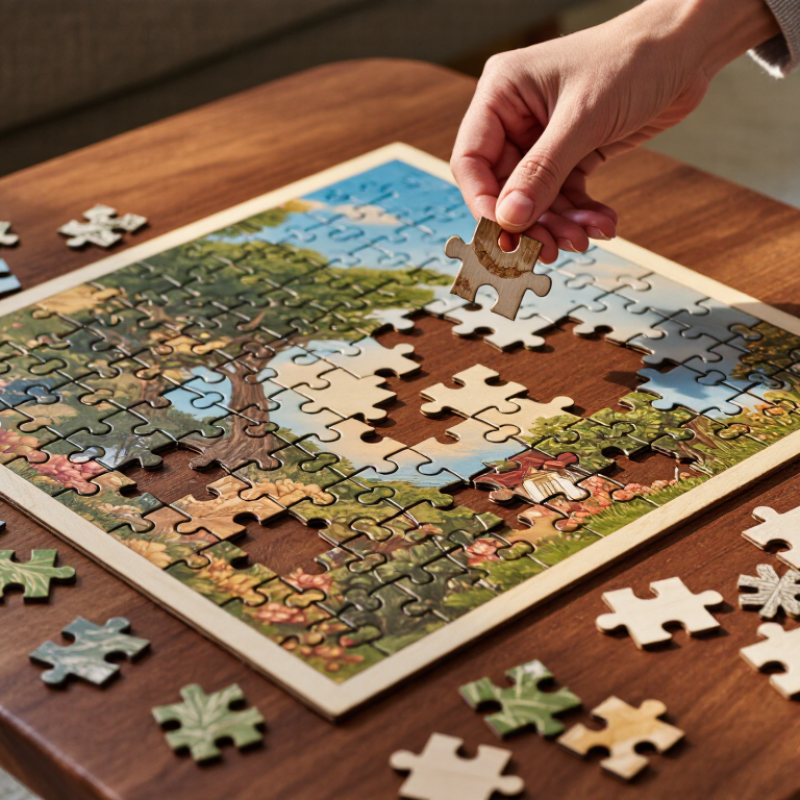
A wooden puzzle combines shaped pieces, visual patterns, and a physical solving experience. The pieces feel warmer and heavier than plastic pieces. A slight grain may guide the fingers, although it can also distract the eye. Many people enjoy the quiet process: sorting pieces beside a window, turning one slowly, and hearing a soft click when it fits.

Cognitive Value: What Peer-Reviewed Research Says About Puzzle Solving

Peer-reviewed research links puzzle solving with attention, visual-spatial reasoning, and problem-solving practice. These tasks require people to compare shapes, hold details in working memory, and revise unsuccessful choices. A 2019 study in Frontiers in Aging Neuroscience reported associations between frequent puzzle activity and better cognitive performance in older adults. However, the study did not prove that puzzles alone caused those benefits. People who choose puzzles may already have healthier routines or stronger interest in mental activities.

Research also suggests that challenging leisure activities can support cognitive engagement across adulthood. The effect depends on difficulty, consistency, and personal interest. An easy puzzle may feel relaxing but offer limited mental challenge. A difficult one can improve persistence, yet it may create frustration. That distinction matters. I have sometimes mistaken finishing quickly for learning deeply. A better measure may be whether the activity encourages flexible thinking, careful observation, and patient error correction. Wooden puzzles support these habits through direct, visible feedback, but they are not a guaranteed method for preventing cognitive decline. More long-term research is still needed.

Why Wooden Puzzles Remain Popular: Durability, Sustainability, and Tactile Play

A wooden puzzle is a set of interlocking pieces made mainly from wood, often cut into playful shapes. Unlike thin cardboard, wood gives each piece a firm edge and noticeable weight. I notice this difference when assembling a puzzle at a kitchen table. Pieces do not bend easily, and the soft click of a correct fit feels reassuring. It creates a slower kind of play. Children can practice matching and spatial thinking, while adults may enjoy a quiet break from screens.

Durability helps explain the lasting appeal. Well-made wooden pieces can survive repeated handling, although quality varies with the wood, cutting method, and finish. A small scratch does not always ruin the experience. Sometimes it becomes part of the puzzle’s history. Sustainability also matters, but wooden does not automatically mean eco-friendly. Responsible production should consider renewable wood sources, low-waste cutting, safe finishes, and long product life. A puzzle used for years may create less waste than a cheaper item quickly discarded. Still, I think buyers should question vague environmental claims. Tactile play adds another layer: fingers feel texture, pressure, and alignment before the eyes confirm success. That sensory feedback makes the activity more engaging, even when the image itself is simple. Some pieces may fit imperfectly, which can test patience rather than provide instant satisfaction.

Article Source:

This website uses cookies to ensure you get the best experience possible. Learn more.